
The impacts of climate change are becoming increasingly direct in forest management and are emerging over ever shorter time horizons. Rising drought risk, more frequent extreme weather events, the spread of invasive species, and the increasing risk of forest fires have a particularly strong impact on stands with poor site conditions, artificial origin, and a long history of unmanaged development.
One such vulnerable forest, highly exposed to climate change, is the municipally owned forest located near the village of Tök in Pest County, in the area of Nyakas Hill.
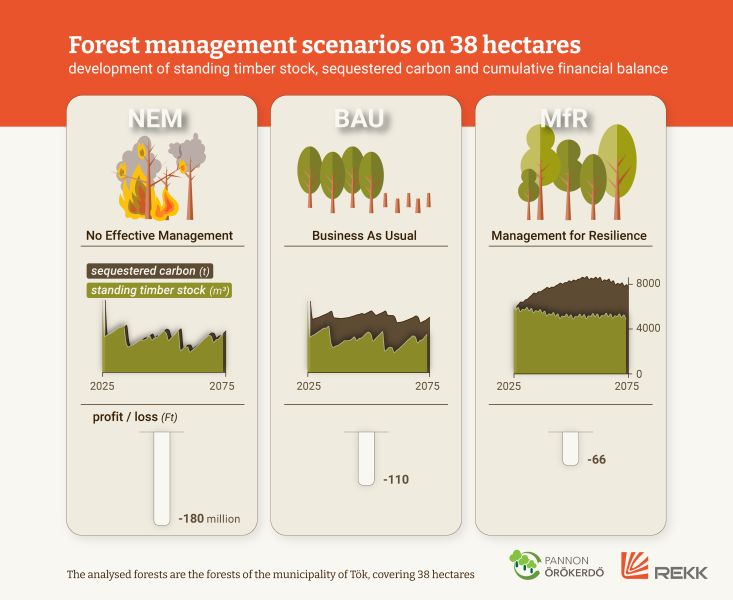
The research examined how different forest management approaches affect the ecological condition, carbon balance, and financial trajectory of the forest stands. The assessment compares three fundamentally different management logics: the Business As Usual (BAU) scenario, representing traditional even-aged management; the Management for Resilience (MfR) approach, based on continuous forest cover and resilience; and the No Effective Management (NEM) condition, representing the absence of meaningful intervention.
Results are summarized in the figure below. Detailes can be found in the attached summary document.
The program consists of disseminating the resultsthrough ways asfield trips when the video reports were shot.